Start to finish
What happens between ringing up and getting the files
On the day
The steps, in order
- Step 1
You describe the problem
By form or by phone, in whatever words come out. The address matters, the rest can be vague.
- Step 2
We work out which service it is
Sometimes that is obvious. Sometimes it needs a question or two back, and occasionally the answer is that you want a roofer or a ground surveyor rather than an aircraft, in which case you will be told so.
- Step 3
Airspace and site get checked
Where the site sits relative to controlled airspace, restrictions and anything else that limits flying is checked before a price is agreed. Exeter Airport, Dartmoor's danger areas and several coastal sites all affect what is possible, and it is far better to find that out now.
- Step 4
A fixed price comes back
One figure for the job, with travel inside the coverage area included. It is agreed before anything is booked, and it does not move afterwards unless you change what you have asked for.
- Step 5
A slot gets set around the weather
Wind and rain both wreck the results, and thermal work needs particular conditions. Slots are provisional until a day or two out for exactly that reason.
- Step 6
The flight
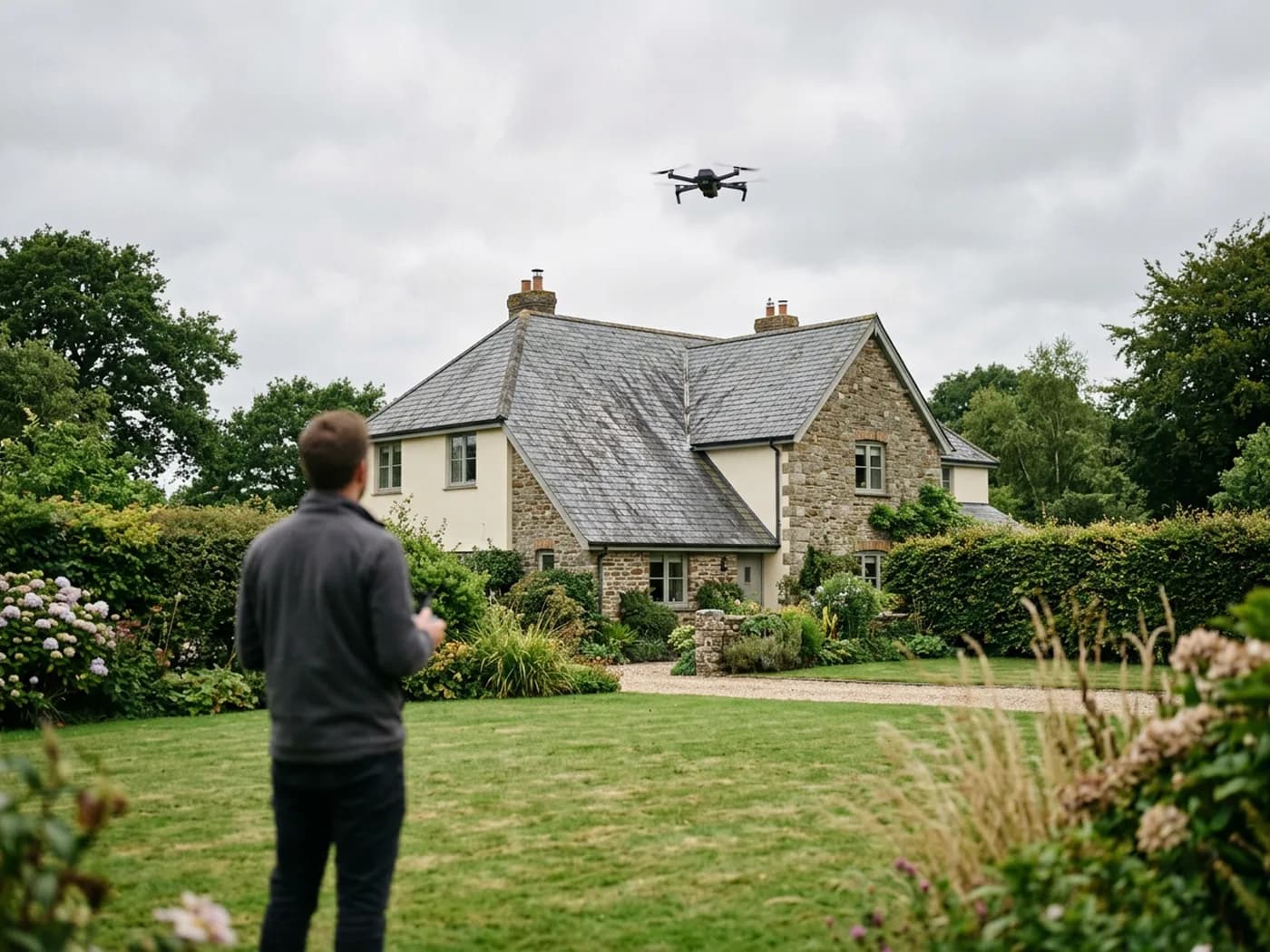
A house is usually well under an hour on site. A larger site is a matter of battery changes and daylight. You are welcome to be there and welcome not to be.
- Step 7
The files and the report
Photographs at full resolution, and where the job needs one, a written report within 48 hours of the flight.
The report
What a report contains
The photographs
Full resolution, each one referenced to the part of the building or the site it shows, so nobody has to guess which slope or which corner they are looking at.
What was found
In plain words. A cracked flaunching joint is described as a cracked flaunching joint, and then in a sentence anybody can follow.
What looks urgent and what does not
Separated deliberately, so a long list does not read as a long list of emergencies. Most surveys find several things and one of them matters this month.
The date and the conditions
When the flight happened and what the weather was doing. That is the part an insurer or a loss adjuster looks at first.
What is not covered
The limits of what a camera can see, said out loud rather than left implied. Nothing under a covering, inside a wall or in a loft has been inspected.
How long the whole thing takes
The flight itself is short. The wait is almost always the weather, and after that the write-up, which is within 48 hours of the flight for any job that includes a report. Photograph-only jobs have their delivery agreed at booking, because editing time depends on how many images there are.
Weather and rules
The rules the flying works under
Registered and certified
CAA registered operator with an Operator ID and a Flyer ID, plus an A2 Certificate of Competency, which permits closer flying to buildings and to people not involved in the operation.
No flying over crowds
An assembly of people is out of scope. Venues, grounds and settings are flown before or after rather than over the top of a gathering, and you will be told that at the enquiry rather than on the day.
Permission to take off and land
The aircraft needs somewhere it is allowed to launch from and a safe distance from anyone not involved. That is arranged in advance, including where the useful launch point turns out to be a neighbour's field.
Insured for commercial work
Cover is with Coverdrone and the certificate is sent to anyone who wants sight of it before a visit, which managing agents and site managers usually do.
Weather limits are real limits
There is a wind speed above which the aircraft does not go up and a rain threshold beyond which the photographs are worthless. Both are treated as hard limits rather than something to push.
Before you book
Common questions
- I do not know what the thing I need is called. Is that a problem?
- No, and it is the reason this site exists. Describe what you can see, or what you cannot, and we will tell you which service answers it. Nobody is expected to arrive knowing the vocabulary.
- What does it cost?
- It is a fixed price per job, agreed before anything is booked, and travel inside the coverage area is part of it. The figure depends on the size of the job and how far away it is, so send the address and what you need and a price comes back.
- How far do you travel?
- Base is Exeter, which puts most of Devon inside an hour and much of Cornwall, Somerset and west Dorset inside two. There are 47 town pages on this site and everywhere between them is covered as well.
- How soon can somebody come out?
- It depends on the diary and much more on the weather, since wind and rain both ruin the work. Ring or send the form and you will get a real answer about the next workable slot rather than a promise the sky might not keep.
- Do you need to come inside the house?
- No. All of this is flown from outside, and for most jobs you do not need to be there at all, as long as we can reach a safe launch point.
- Is it legal to fly over my neighbour's garden?
- An aircraft can pass over land the operator does not control, but it has to keep a safe distance from people and property that are not part of the job, and it has to take off and land somewhere with permission. Both are worked out before the visit rather than argued about on the day.
- What happens if the weather is wrong on the day?
- It gets moved, and you are told as early as we know. Photographs taken in driving rain or a gusting wind are not worth having, and handing over a set you cannot use helps nobody.
- Can you tell me what a repair will cost?
- No, and anyone who quotes for a repair off a photograph is guessing. The report says what was found and where it is, in a form a roofer or a builder can price properly.
See which one fits
Tell us what you need with Drone Services Devon
Tell us the address and what you need looking at. Sam Hembury will come back with a fixed price and the next available slot.